quasi
Report This Comment
Date: July 07, 2026 01:58PM
Solar and ranching or farming don't have to be an either-or situation. Florida
has huge ranches that could be used in this way under its ample sun, and having
often seen cattle trying to huddle in the shade of sparse trees on some of the
grazing areas I think they would appreciate the shade and might perhaps be
healthier because of it - heat stress is a bitch here for humans and animals
alike.
per J&R Pierce Family Farms of New York state:
"When people first started opposing solar on farmland, the biggest concern
was that it would take productive farmland out of agriculture.
I get it. Farmland is valuable, and none of us wants to see it wasted.
So the industry responded, and something new was born: solar grazing. Solar
grazing, a form of agrivoltaics (farming under and around solar panels), isn’t
anything new. It’s been done in Europe for decades.
But here in the United States, it took off quickly, with the number of solar
graziers doubling between 2020 and 2024.
Sheep have been the traditional “plug-and-play” option. They work well on
virtually any solar site. They don’t jump or chew (like goats), and their
small, nimble bodies make it easy for them to maneuver under and around panels
to eat the vegetation.
Grazing with sheep provided a valuable service to solar companies that needed
the vegetation managed anyway. And for sheep farmers, solar grazing was huge,
providing an additional revenue stream, access to land, and improved
environmental conditions (with added shading and moisture retention benefiting
their flocks).
Yet shortly after, the conversation shifted again. People argued that solar
grazing “isn’t real farming,” since there isn’t enough demand for lamb.
Therefore, grazing sheep isn’t a “meaningful agricultural use.”
And while 70% of our lamb supply is imported, signaling that there IS in fact a
demand that needs to be filled, I don’t disagree with this fact: Americans eat
far more beef than they do lamb (about 1 lb of lamb per person, annually, versus
60 lbs of beef, per person).
So we went back to the drawing board.
We’ll always graze sheep on solar sites. They work great on sites that
weren’t planned with agricultural dual use in mind. And we’re sheep farmers
at heart.
But we also recognize that there’s a huge demand for local, affordable beef.
And we want to help fill it. We’ve raised beef since 2022, but this season
marks the first time that our cattle have grazed solar.
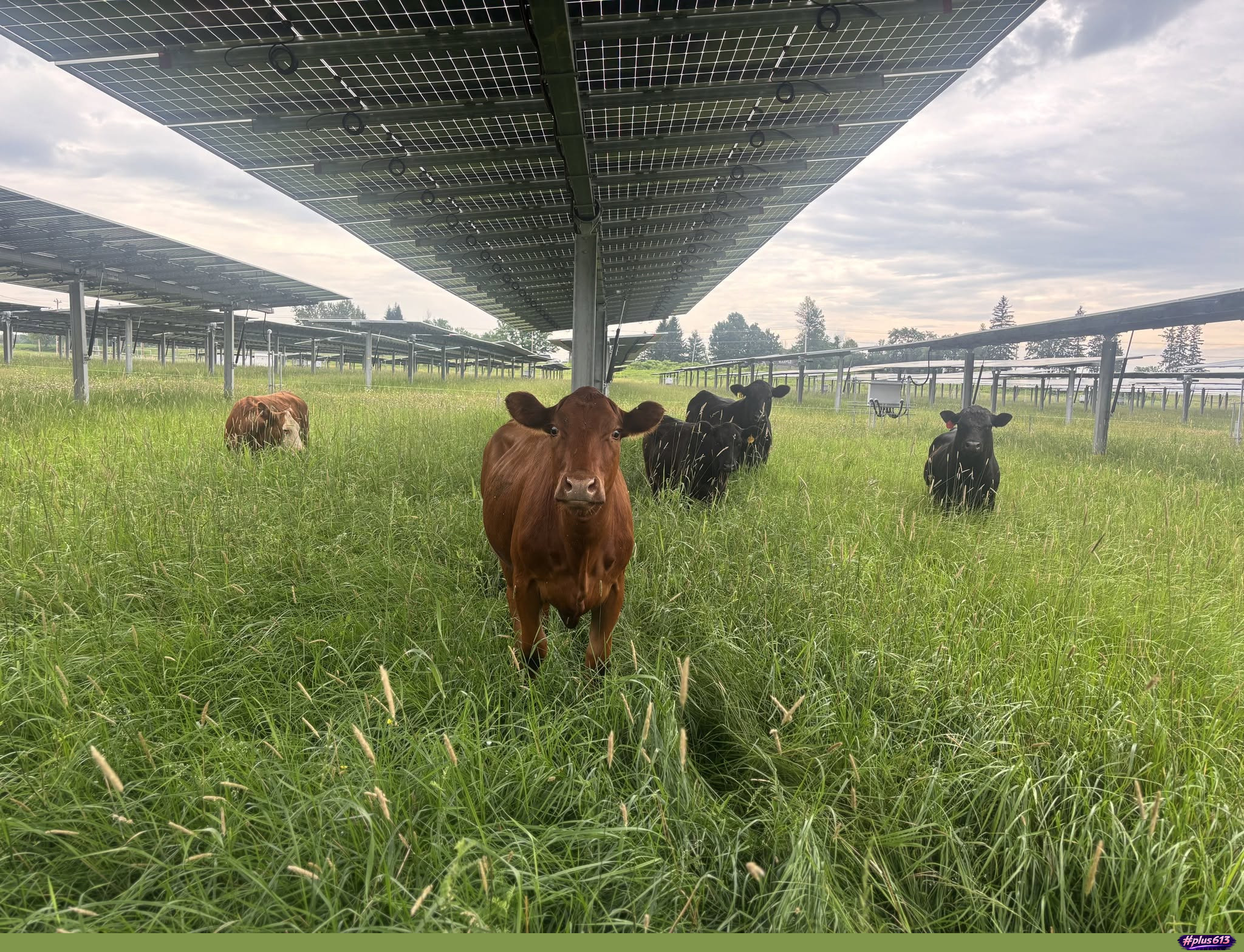
Worth noting is that the site pictured here was not designed for cattle and has
tracking panels that are slightly more elevated when fully flat, but when they
tip to follow the sun, look much like traditional layouts and are low.
And the cows are doing fine.
We’re not the first people to do this. Cattlevoltaics is growing, and we stand
on the shoulders of many talented researchers and ranchers who came before us,
who’ve been daring enough to experiment and to continue to test the boundaries
of what’s possible.
First, it was sheep. Now it’s cattle. Tomorrow it could be something else.
Agriculture has never stood still.
And neither will we."