djyaecomcastnet Report This Comment Date: April 05, 2006 03:31AM
A and b are zero...
Temuchin Report This Comment Date: April 05, 2006 03:43AM
I am waiting for Siouxie to give us an answer on this.
She is the smartest female in Australia behind Sandra Sully
billybob Report This Comment Date: April 05, 2006 03:46AM
Actually, it is wrong. Whoever drew up that example did not do it correctly
and made a goose of it.
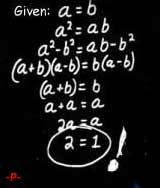
a=b
a^2 = ab
a^2 + a^2 - 2ab = a^2 + ab - 2ab
2(a^2 - ab) = a^2 - ab
The rest will fit into place.
Anonomus Report This Comment Date: April 05, 2006 03:50AM
The fallacy is in the given, a=b. "a" does not equatl "b"
any more than circles are square. In an equation where you can just make things
up, anything is possible. Even 2=l
pro_junior Report This Comment Date: April 05, 2006 04:30AM
or, i before e except after c....
cesiuminjector Report This Comment Date: April 05, 2006 05:10AM
i understand what your getting at 27229, but what if "a" is a
function and "b" is the tangent line approximation of the function
"a". Given a domain of "b" where it closely approximates
"a", mathamaticians frequently (and must) substitute values of
"b". im sorry to inform you that "a" can equal "b"
aDCBeast Report This Comment Date: April 05, 2006 06:02AM
Anonomus@27229 is right. A = B or the 2nd assumption is BS.
cesiuminjector Report This Comment Date: April 05, 2006 06:31AM
beast - that aint no assumption - ive taken enough calc to show its true. Thats
actually pretty much the entire idea behind calculus. Using derivatives, tangent
lines, tangent planes, ect to determine values relating to a function. If you
limit the domain of a derivative, it will (for all practical purposes) be equal
the original function in that domain. you can substitute a for b because they
can be equal. Its no different than the sin of theta for small numbers is
approximately equal to the tan of theta for small numbers.
aDCBeast Report This Comment Date: April 05, 2006 07:13AM
Uh .. wrong. a2=ab is an assumption. A bad one. One that shows this to be
miserably false on all counts.
Keep trying geek.
i_hate_you_cunts Report This Comment Date: April 05, 2006 07:46AM
cockBeast:
cesiuminjector is right.If you had passed high school maths you'd understand
what he's talking about.Keywords here:"domain limitation".Notice how
the very top line doesn't say" -inf
shaDEz Report This Comment Date: April 05, 2006 08:23AM
a2=ab
b=2
Anonymous Report This Comment Date: April 05, 2006 08:34AM
DIVIDE BY ZERO PPL!
shaDEz Report This Comment Date: April 05, 2006 09:54AM
system error occured in line?
Anonymous Report This Comment Date: April 05, 2006 03:11PM
line 4, (a-b)=0, so you can't go from line 4 to line 5
because, if you have 0*anynumber = 0*anyOTHERnumber, you can't, and mustn't say
: anynumber =anyOTHERnumber but 0=0 (latêtatoto!)!
Anonymous Report This Comment Date: April 05, 2006 03:13PM
hum, little problem with the formula.. this is
"0*anynumber=0*anyOTHERnumber"
And "anynumber=anyOTHERnumber"
and "0=0"
mkcerusky Report This Comment Date: April 05, 2006 04:15PM
Does any of you know why in these kinds of computations one can't divide by
zero?
cesiuminjector Report This Comment Date: April 05, 2006 06:19PM
in layman the reason you cannot divide by zero: how many times can something go
into nothing
im sure this is a fallacy, but its not readily apparent to me why
in line 4, there is just the expanded a^2-b^2 which is equal to (a+b)(a-b), it
doesnt say a*b anywhere in line b. The next algebraic operation is to devide
(a-b) from both sides of the equation - which is perfectly legal
nevermind - im going to send this to one of the math proffesors at cal poly -
they will respond back with the right explanation
cesiuminjector Report This Comment Date: April 05, 2006 06:22PM
in line 4 - sorry typo
Anonymous Report This Comment Date: April 05, 2006 08:26PM
x=0.9999... repeating
10x=9.9999... repeating
10x-x=9
x=1
how can x=0.9999... repeating and x=1???
explain please
shaDEz Report This Comment Date: April 05, 2006 08:44PM
i'm guessing it is estimating to =1 when you forced a conclusion out of it
it is safe assume
if x=0.9999...
then 10x-x=9
even though it would actually be 8.9999...
Anonymous Report This Comment Date: April 05, 2006 11:10PM
Now I know why I couldnt give a rats arse at school.
cesiuminjector Report This Comment Date: April 05, 2006 11:54PM
i can supply you with more math phenomena - like how the line y= (1/x) where
x exists from 1 to positive infinity and then this function is rotated about the
x-axis (makes a giant funnel shape lying on its sided). This shape has infinite
surface area, yet finite volume.
i_hate_you_cunts Report This Comment Date: April 06, 2006 01:20AM
cesiuminjector said :
i can supply you with more math phenomena - like how the line y= (1/x) where x
exists from 1 to positive infinity and then this function is rotated about the
x-axis (makes a giant funnel shape lying on its sided). This shape has infinite
surface area, yet finite volume.
Groovy.Do it.DO IT!No, seriously I would like to see more.
shaDEz Report This Comment Date: April 06, 2006 01:49AM
nice...
pro_junior Report This Comment Date: April 06, 2006 04:47AM
ur^2...
mkcerusky Report This Comment Date: April 13, 2006 03:07PM
The point with division by zero is that division is the inverse of
multiplication, when you multiply something by zero you always get zero, and you
never get a number different from zero. Th function of multiplying by zero is
nor injective neither injective, so it cannot be inverted.
In other words if n*0 = 0, and you try to divide 0 by 0 you cannot say what what
was the value of n. Moreover, no number M different from zero can be the result
of an operation n*0=M thus, given M you can't find out what was n.